
Guy Baron is an academic and a singer-producer working under the name Semi Precious. His musical practice fuses electronic music production and songwriting to explore notions of bedroom production and hauntology, with previous musical works being endorsed by The Sunday Times (‘real emotional depth’), The Guardian (‘subtly dislocating beauty’) and i-D (‘celestial pop suspending and spinning in a dark and lonely bedroom’). Baron serves as a lecturer of music production at Goldsmiths University, as well as leading practice-based modules at London South Bank University. His doctoral research focused on aspects of reminiscing and retrospection in the context of electronic music making.
Yasmin Vardi’s work incorporates video, installation, photography and text and focuses on trauma, the politics of form and mechanisms relating to constructed realities. She holds an MFA from Slade School of Fine Art, and exhibited in Open City Documentary Festival, Venice’s 17th Biennale, London’s Architecture Festival and greengrassi Gallery.
Conceived as a collaboration between singer-producer Semi Precious (Guy Baron) and video artist Yasmin Vardi, the audio-visual piece for Queen Aquamarine – the lead track from the new Semi Precious EP – explores bedroom production aesthetics using iPhone footage and digital manipulations. It further addresses the notion of feeling comfortable and liberated in one’s own body, as experienced in private spaces and moments of exploration and play. In the conversation below, the two artists reflect on their approaches to bedroom production.
A conversation on bedroom production in audio-visual piece Queen Aquamarine
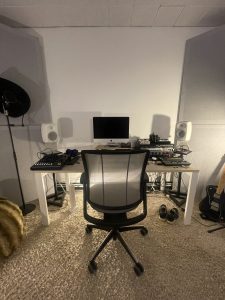 Guy Baron: I want to start the conversation discussing this feeling I get often: almost like a longing for a period in my life when I shared a place with a flatmate and when my bedroom, where I had a tiny folding desk, was basically the space where I did everything. I find myself wanting to revert to doing everything from my bedroom, having my shoes neatly placed on the side of bed. I’m not sure why but I find this living-working setup kind of comforting and almost zen-like?
Yasmin Vardi: Even monk-ish
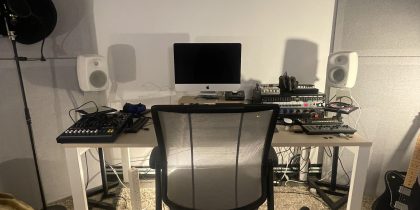
GB: Yes! And it can on one hand feel claustrophobic or limiting but on the other hand there’s a certain coziness to it. And now I kind of lost that mode of living-working. I suppose that’s why I made my current music studio look a bit like a bedroom, with a shoes-off policy and a thick rug. I recreated a bedroom in my work environment.
YV: For me it’s the case that some creative work can’t be done in the studio. For example, there are certain scenes that I would not be able to write in my actual studio. I know that I will only be able to write them in my bedroom, surrounded by piles of clothes and dirty laundry etc. On the contrary, in the studio (or in a recording studio for that matter) there’s a disconnection from “real life” and house chores that enables a different stream of thought and workflow. But with certain things you’re working on you need that sense of closeness, a proximity to real life that gives you a sense of perspective
* * * * *
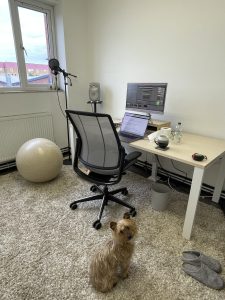 GB: So this thing of different work environments is something I talk a lot about with other music producers… and also about the idea of navigating between two modes of creative making: on the one hand you need to be disciplined, to treat creative work as a “job” and commit yourself to the process, and then on the other hand there is another mode of creativity that is more about “play” or playfulness. And I think that often when you go into a “real” studio you’re inevitably in labour rather than play mode. Obviously sometimes this is useful, if you work on things like mixing and tweaking specific arrangement details. But I often find that the initial spark of inspiration needs to come from a place of almost allowing yourself to do something you’re not supposed to do, or escaping to music making when you need to do other things. This takes me to the time I was still recording in my actual bedroom, when I used to find myself being “tempted” to make music in the middle of the night
YV: I completely identify. There is certain writing that I can do on the bus, for example, or certain ideas that come […] There’s a very interesting text by McKenzie Wark that touches upon life and art and the boundaries between them (Wark, 2023), where she basically says it’s impossible to draw a line between creative writing and labour. And so I feel that this links to a lot of conversations we had about the need to fuse real life and art making – you could go to a party or sit in your bedroom [as opposed to being in the studio] and something will come to you, there’s no separation. But I still find that I need to have a boundary: when I have the “labour” space, I am then able to cross it into the private-life realm
* * * * *
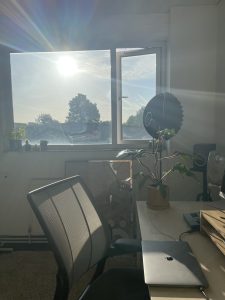 YV: Thinking about the inability to “discipline” one’s own creative practice… It’s obvious that our joint practice, with its bedroom production leaning, tends to be unstable and unpredictable
GB: I think there is discipline in our joint work, but when we collaborate ultimately things seem to happen more organically by means of improvisation. And this is something that is clearly intertwined with bedroom production as an ethos of working with what you have, with what is available at hand… and responding to a given space, rather than being in that labour-studio mode
YV: I think that DIY playfulness is something that really captures people. I recently did a lecture for undergraduate students and talked about Tyler the Creator in the context of visual branding. I found that the students were mostly captivated by Tyler’s earlier DIY aesthetics
GB: What you’re mentioning now for me taps into something else: the fact that when you’re just starting to develop your creative practice, you’re essentially less aware or conscious of what you’re doing and trying to achieve. And then the more we refine our practice, the more we become aware – which is a good and a bad thing, as at this point we approach the process with a set of expectations and with an idea of the final outcome. Like with your Tyler the Creator example, where the spontaneous and goofy aesthetics at some point became something that is constructed and then capitalised upon
YV: But there’s a middle ground between the commodification of an aesthetics and the initial bedroom playfulness… it doesn’t have to be binary. For me it’s about finding that sweet spot where intimacy is kept at a distance. That’s the secret
GB: I guess this also relates to irony in art more broadly, and to things like pop art for example, where it’s not altogether clear if the artist is doing something in a self-conscious and ironic way or from a place of genuine curiosity and naivety. That’s also what fascinated me about sample-based, home-produced vapourware tracks when they first surfaced on reddit communities around 2011: that sense of ambiguity and that it wasn’t clear whether these music producers were genuinely into shopping mall music and skyscrapers in Hong Kong, or that it was…
YV: A commentary
GB: Yes, a commentary about consumerist culture
YV: This is what I feel makes the video we’ve created for Queen Aquamarine interesting. It has this duality or ambiguity that complicates the seemingly self-indulgent “selfie” footage
GB: It’s interesting you say that… I do feel that with my previous musical works there was this duality you mention. For example, in my album Ultimate Lounge (Baron, 2016) I sampled easy listening music that is clearly very “cheesy”. So the album became quite ironic and self-aware. But with Queen Aquamarine it was something else for me, for me it was quite naive
YV: I think we both approached the making of this video with a sense of naivety, but the result […] there’s another thing that’s happening there. For example, the way the video is spliced and edited in an almost brutal way into different strips (which reminds me of that distinction we talked about earlier between leisure and labour)
GB: For me the visuals in Queen Aquamarine are more associated with a sense of softness, like a mirror room. Or maybe like little ripples of the self that are exposed in a private bedroom environment
* * * * *
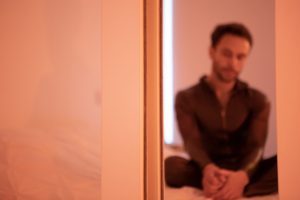 GB: I want to move for a moment to discussing ASMR YouTube videos, which emerged about a decade ago and became a massive internet phenomenon, with their whispery and comforting voices and as an example of bedroom production. There’s something about those videos I still struggle to articulate, like a sort of digital intimacy: the fact that there’s someone out there on the other side of the world that seemingly “cares” for you… and the need to make up for some lost sense of care. It’s almost like an intimate connectivity that is created through the digitally mediated
Photograph by Yasmin Vardi
YV: For me it’s a one-step-too-close sort of thing, or something that is simultaneously pleasant and intimidating. I think that Queen Aquamarine, for example, brings this quality of something that is perhaps a bit too close. The filming is as intimate and private as it gets
GB: This is also something I identify in my teaching when I discuss vocal production in relation to notions of intimacy. The obvious example in this context is the use of compression on whispery vocals to create an overly intimate and proximate sound (like the case with Billie Eilish’s vocal production). So the result is almost like a forced sense of intimacy
YV: It’s also happening on social media, where people share highly intimate moments in their homes or on vacation – but it’s all being highly “compressed” and mediated. And this also links to the idea of authenticity, which on social media is often fake authenticity as there’s nothing genuine about these supposedly intimate and “spontaneously captured” moments. This for me calls to mind the feeling that comes after having casual sex – the notion of a very intimate, shared moment that becomes fleeting straight after
GB: That moment when you put your clothes back on and you become two strangers again
YV: Exactly. And it’s interesting to think how this dual feeling can be translated as a sonic and visual aesthetics. This idea of lovers-strangers and the fleetingness of intimacy
* * * * *
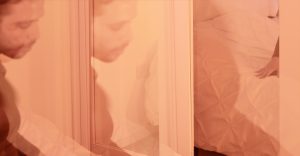 YV: I had this thought about bedroom production, or the notion of “four-walls”… as a space that is private but has capacity for multiple potentialities. A place where everything happens, unlike a studio. So a bit like a mirror room or a black box. It reminds me of a Diego Marcon exhibition I saw recently in Central London, where the artist created a separate space within the gallery using a white curtain (Marcon, 2023). So only when you entered that four-wall white curtain space – that’s where the work existed. I found it fascinating… almost like an access point to an even more intimate space. It’s like a deliberate decision to use only a designated, small section of that big gallery space. It ultimately works on a play between bringing something closer and distancing it
GB: Yes, these notions of proximity and distance are one aspect. But there’s also a link to what we always talk about – the conscious decision to use limited resources to create something that is “smaller” or reduced. That’s a very bedroom production thing for me
YV: Agreed
GB: I can say that, from a music production perspective, when you work with a DAW like Ableton Live or Logic – you can still make music that sounds very professional and pristine from your bedroom using these software, which are also used in professional studios. Maybe what is actually at stake here is the idea of limitations and creativity: so when you have all these endless digital possibilities for editing your music, how do you set certain limitations for yourself to maintain creativity
YV: For me this also links to conversations about the commodification of the self and the authentic… So yes, like you say I often use whatever devices I have at hand, like an iPhone, for my filming, in a way that encapsulates that bedroom limitations ethos. But then in the art world or in the music industry this “small” bedroom-y aesthetics has also become a token
GB: Yes, I very much agree. When I talk about bedroom production, I’m often very conscious that it can come across as a glorification of DIYness. And I also feel that sometimes I sort of “fake” certain DIY qualities in my music. After all, I did work with a mixing engineer and did the final stages of the production for my latest EP in a professional recording studio. And whilst some of my recordings on this EP were spontaneous one-takes, others were done a few times and then edited
YV: I feel this is a very important point, also thinking about our joint creative work… that duality between actual bedroom aesthetics and the token it can become or the way in which it is being faked, which is obvious to us but not for others
GB: It’s almost like you’re iconising the “small” and the rough-round-the-edges… it’s a bit like nostalgia when I come to think about it: like the thing I said at the beginning of our conversation about the time when I first started making music from my bedroom… it comes with a certain glorified view of that experience through the lens of time passed. Like the notion that it was easier to create when we had less resources available. But it’s kind of misleading as it’s done retrospectively
YV: And you choose what to forget
GB: Absolutely. My question is: does it matter? [if bedroom production aesthetics are glorified/faked or not]
YV: I don’t think that’s necessarily the point. I just feel it’s important to put this awareness on the table, as an important side note on bedroom production in our joint work
GB: One thing I do feel though, and this is something that is talked about in music production scholarship too: for me, being a bedroom producer who has always used digital software and never really worked with analogue gear (that’s why I also feel somewhat alienated in professional studios), there’s definitely a sense in which trying to create limitations for myself within the endless possibilities of digital software is really an attempt to find the analogue within the digital. For example, committing to one-take recordings, even though each recording can be endlessly tweaked
YV: And that’s exactly what we did with the Queen Aquamarine video too. I wasn’t present in the room when the video was shot and it was all about that one-take of improvisation. Obviously, we haven’t used film and the footage was edited digitally, but in terms of the process it does make a difference
GB: And that one-take we ended up using for the video, that’s the one where I was least conscious of my performance
YV: That aspect of one-takes and improvisation was certainly key for this work. The sense of “dance like no one is watching”… That’s the essence of the work
GB: I feel everything you just described is intrinsic to aesthetics of bedroom production. For me they are about unedited versions of ourselves, as experienced in very private moments. Like when I have my shared flat to myself for a weekend and I experience a sort of cathartic feeling. It’s these moments when something very real and pure comes out and no further “takes” are needed. Because I’m simply having fun and present – I’m in the moment.
—-
Baron, G., 2016. Semi Precious – Ultimate Lounge (LP). [Sound Recording] (Squareglass Records).
Marcon, D. (2023). Dolle. Sadie Coles HQ, London. Retrieved from:
https://www.sadiecoles.com/exhibitions/972-diego-marcon-dolle/installation_shots
Wark, M. (2023, November). Critical (Auto) Theory. Retrieved from e-flux Journal:
https://www.e-flux.com/journal/140/572300/critical-auto-theory/
—